

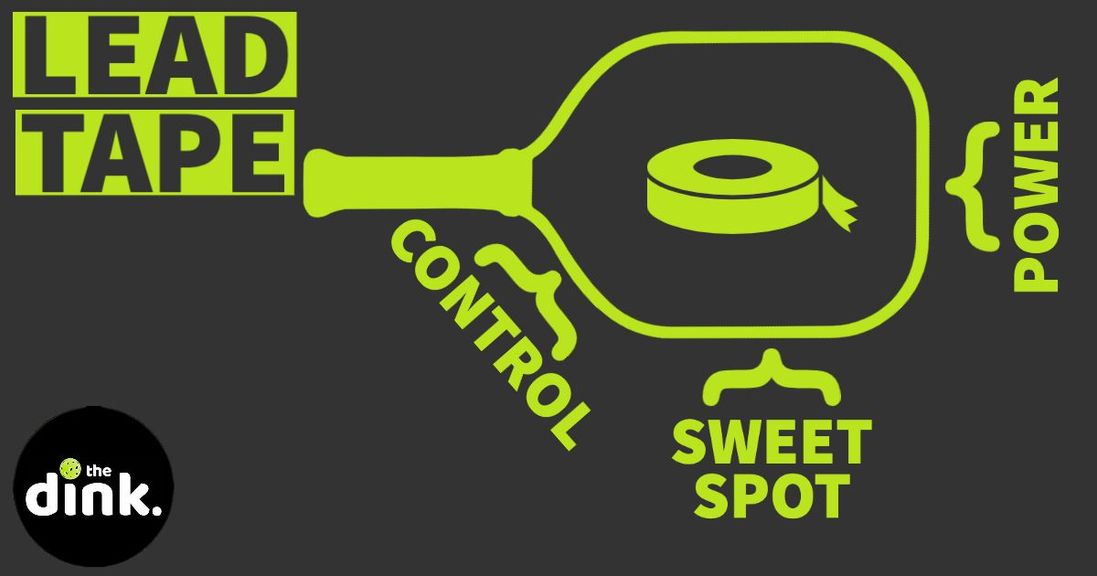
Lead tape for pickleball paddles adds power, stability and a bigger sweet spot, but only if it goes in the right zone. Here’s where to put it, how much to add and what the 2026 USA Pickleball rules allow.
More and more pros and advanced-level players are adding lead tape to the edges of their pickleball paddles to add weight or change the weight distribution.
Adding weight adds power to your game. Force = mass x acceleration. More mass, more force.
When it comes to weight distribution, the effects vary based on where the weight is placed.
Love pickleball? Then you'll love our free newsletter. We send the latest news, tips, and highlights for free each week.
Where to Put Lead Tape on a Pickleball Paddle
To put it simply, there are three zones where weight can be added:
- Zone 1 - Weight added to the top of the paddle adds power. The trade-off comes with decreased hand speed.
- Zone 2 - Weight in the middle of the paddle, along the sides at 3 and 9 o'clock, has a moderate effect on power and hand speed. This zone is best for stability. It will prevent your paddle from rotating when contact is made with the ball. In turn, the sweet spot can actually feel larger.
- Zone 3 - Weight added in zone 3 will have less of an effect on hand speed compared to weight in the other zones. It also comes with increased stability and an expanded sweet spot.
How Much Lead Tape Should You Add?
Less than you think. A few grams changes how a paddle feels in your hand, so start small and build.
Weigh your paddle first if you have a kitchen scale.
Then add tape in matching pairs on both sides of the paddle so you don't throw off the balance, and play a session before adding more.
Elongated paddles already carry more weight up top, so go easy in Zone 1 if that's your shape.
For the deeper dive on twist weight and swing weight, see our paddle customization guide.
Why Add Lead Tape to Your Pickleball Paddle?
We've gone over how adding weight to your paddle can increase your power and stability in the hand, but there are a number of other benefits to experimenting with paddle weights, including:
- More spin: A heavier paddle can help generate more spin on the ball, giving you greater control over the trajectory of your shots. Your paddle's surface still sets the ceiling, though. USA Pickleball's new spin rate test caps newly certified paddles at 2,100 RPM.
- Improved consistency: With a more stable and balanced paddle, you may be able to hit shots with greater consistency.
- Greater durability: Tape along the edge can add a layer of protection against impacts and wear and tear.
- Reduced vibration: Adding weight to the paddle can reduce vibration and shock, making it more comfortable to use for extended periods of time.
"Lead tape has changed my game dramatically.
Since generating power at my age is not an issue for me, I have added lead tape to Zone 3 on my paddle (on the bottom of the head of the paddle), bringing it from 7.9oz to 8.5oz," says Brodie Smith, who writes many of our paddle reviews.
"This slightly reduces my hand speed, but in return it opens up my sweet spot & creates much more control for dinks, resets, and thirds."
 Justin Barton
Is Lead Tape Legal in Pickleball?
Yes. USA Pickleball's official rulebook lists weighted tape as a legal alteration, and there's no limit on total paddle weight.
The catch is placement.
Tape on the paddle face can't sit more than half an inch inside the edge (or edge guard), or more than one inch above the top of the grip.
A strip across the middle of the hitting surface is out.
Pro events follow the UPA-A paddle guidelines, so check those if you're entering one.
Prefer built-in weights?
Paddles like the Selkirk Omni and Mizuno's adjustable-weight paddle now ship with their own systems, and the rules allow manufacturer weight systems too.
 The Dink Media Team

Where to Buy Lead Tape for Pickleball Paddles
The placement and amount can be completely customized to your liking.
We also recommend adding electric tape over the lead tape to ensure everything holds together.
Most paddles weigh between 7-8.2oz off the shelf. These days, players are adding tape and playing at a final weight of 8.5-9oz.
Take your paddle from off-the-rack to custom fitted. Experiment with additional lead tape in different positions.
If nothing else, at least you can blame your next unforced error on the tape.
 Luke Burton
Key Takeaways
- Zone 1 (top): more power, slower hands.
- Zone 2 (sides): more stability and a sweet spot that feels bigger.
- Zone 3 (low on the head): stability with the least hit to hand speed.
- It's legal. USA Pickleball allows weighted tape as long as it stays within half an inch of the edge or one inch above the grip.
- Start small. Add a few grams in matching pairs, then build.
Frequently Asked Questions
Where do you put lead tape on a pickleball paddle?
Put it on the edge of the paddle in one of three zones. The top (Zone 1) adds power, the sides at 3 and 9 o'clock (Zone 2) add stability, and low on the head near the throat (Zone 3) adds stability with the least loss of hand speed.
Is lead tape legal in pickleball?
Yes. USA Pickleball allows weighted tape on a certified paddle, and there's no maximum paddle weight. On the face, tape must stay within half an inch of the edge or edge guard and no more than one inch above the grip.
How much lead tape should I add to my pickleball paddle?
Start with a few grams, split evenly into matching strips on both sides of the paddle. Play with it, then add more in small steps. Many players end up between 8.5 and 9 ounces total.
Does lead tape actually help in pickleball?
It can. Extra weight adds power and stability and can make the sweet spot feel bigger. The trade-off is slower hands, especially with weight at the top of the paddle.
Is tungsten tape better than lead tape?
Tungsten tape does the same job without lead, which is why players with toxicity concerns choose it. It usually costs a bit more. Either one counts as weighted tape under USA Pickleball rules.


Love Pickleball? Join 100k+ readers for free weekly tips, news & gear deals.
Subscribe to The Dink